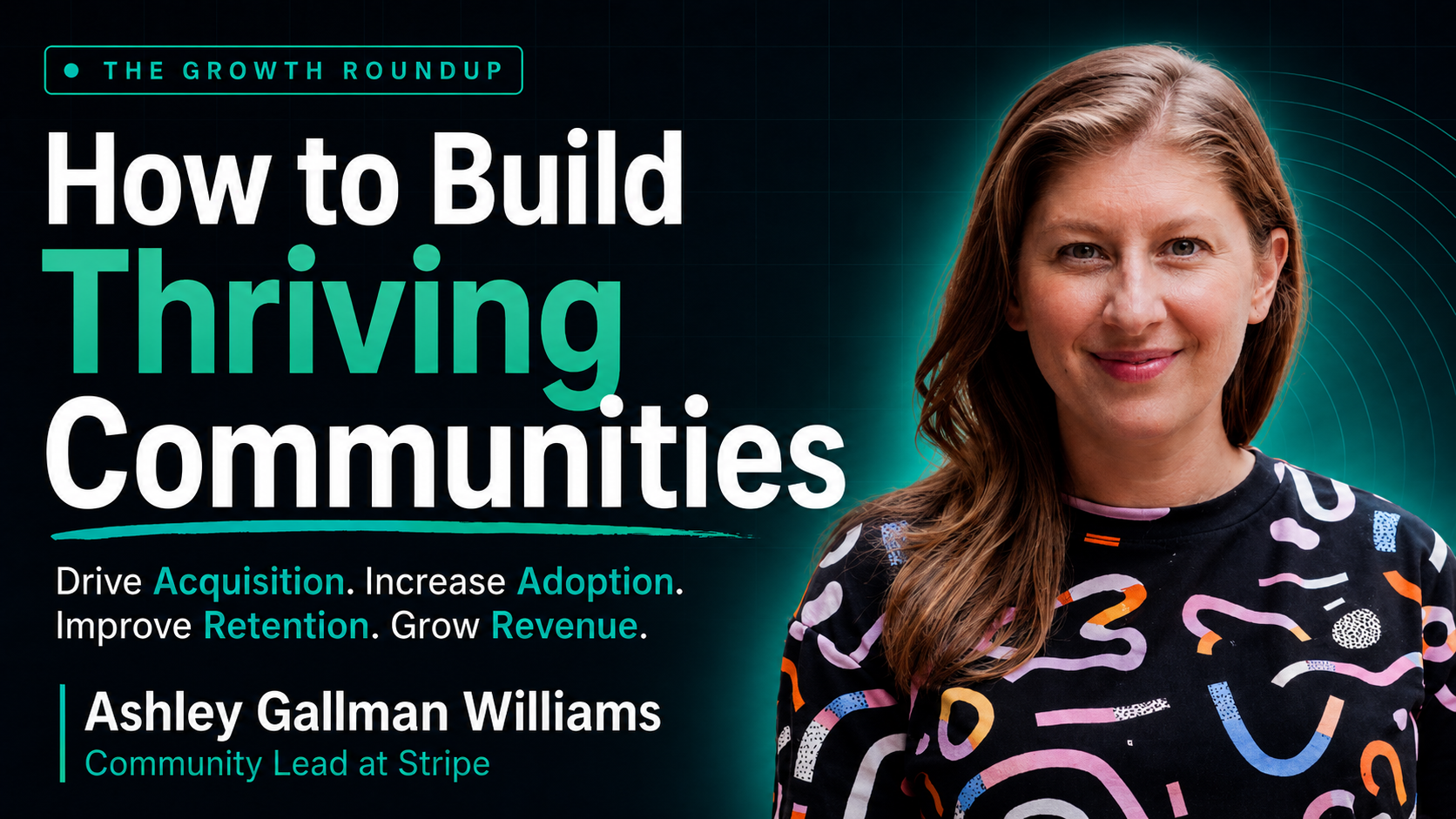
Lessons from Ashley Williams on using community to strengthen acquisition, product adoption, retention, and monetization
Community is often treated as a brand initiative.
The best companies treat it as growth infrastructure.
A strong community can help a subscription business acquire customers through word of mouth, increase product adoption through peer education, improve retention by creating deeper relationships, and support monetization by helping users understand more complex products.
But most companies do not begin there.
They start by launching a Slack channel, opening a Discord server, or adding a forum to their website.
A few people introduce themselves. Someone shares a product update. Engagement gradually disappears. Six months later, leadership starts asking why the company invested in community in the first place.
The problem is not the platform.
The problem is that the platform was mistaken for the community.
In a recent Growth Roundup session, I spoke with Ashley Williams, Community Lead at Stripe, about how great communities are built and how they can contribute to subscription growth.
Ashley has spent almost 20 years building communities across Wix, Airbnb, ClassDojo, and Stripe. She began at Wix when it was still a roughly 100-person startup and helped turn a physical coworking space into a global ambassador program. She later built communities for Airbnb Experience hosts, Airbnb Homes hosts, teachers at ClassDojo, and now Stripe users and builders around the world.
Her central lesson is simple:
Do not start with the community platform. Start with the people.
Watch the full talk here:
Community is human infrastructure
Technology companies are conditioned to begin by building something.
Choose the software. Configure the channels. Create the onboarding flow. Announce the launch.
Community requires a different approach.
Before selecting Slack, Discord, a forum, or an event format, you need to understand:
- Who should be connected?
- What do they already care about?
- Why would they help one another?
- How do they naturally prefer to gather?
- What value can they create together that the company cannot provide alone?
Ashley compared building a community to designing a product.
You would not create a product without researching the user, understanding the problem, and validating the behaviour. Community should be approached with the same discipline.
The online space is only a tool the community uses. It is not the community itself.
The Grow, Engage, Impact framework
There is no single metric that defines a successful community.
A startup with its first 50 customers should not measure community in the same way as a public company with millions of users. Even inside the same company, the purpose of a community may change as the business grows.
Ashley uses a three-part framework:
1. Grow
First, establish the human infrastructure.
Who belongs in the community? Where do they gather? Who leads it? Are enough people participating for the group to become useful?
Growth metrics might include:
- Number of members
- Community leaders recruited
- Events organized
- Event attendance
- New local chapters
2. Engage
A large community is meaningless when nobody participates.
Once the community exists, the next question is whether it is active, healthy, and valuable.
Engagement metrics might include:
- Active members
- Repeat event attendance
- Posts and discussions
- Member satisfaction
- Connections made between members
- Contributions from community leaders
As Ashley put it, a “sad, dead zombie community” is not much better than having no community at all.
3. Impact
Growth and engagement create the foundation. Impact explains why the community should continue to exist.
For a subscription business, impact could include:
- Increased product adoption
- Higher conversion
- Improved retention
- Better customer education
- Stronger word of mouth
- More qualified leads
- Product feedback
- Revenue growth
The three stages create a flywheel.
When a community delivers meaningful impact, members become more engaged. Engaged members attract new people. Growth creates more opportunities for impact.
Start with existing green shoots
The best early community members may not be your largest customers.
They may not be the users paying you the most money or logging into your product most frequently.
Instead, look for the people who are already behaving like community leaders:
- Who is talking publicly about your product?
- Who is teaching other people how to use it?
- Who creates tutorials, templates, events, or content around it?
- Whose career or business depends on your product?
- Who is already answering questions for other users?
These people are not merely using the product.
They are building part of their professional identity around it.
Ashley calls these existing behaviours “green shoots.”
Instead of trying to manufacture a new behaviour, find the energy that already exists and amplify it.
This is how she approached the Stripe community. She looked for people who were already talking about Stripe and engaging audiences around its products. She then contacted them directly and asked what a valuable Stripe community could look like, how they would want to participate, and what they would want from it.
The community was not designed in isolation and handed to users.
It was built with the people who were already acting like its leaders.
How community supports subscription growth
Subscription growth is often broken into three areas:
Acquisition, retention, and monetization.
A well-designed community can influence all three.
Acquisition
Communities create word of mouth, advocacy, social proof, and warmer introductions to a product.
When users teach others, organize events, publish tutorials, or share their results, they create distribution that the company does not have to manufacture alone.
Community does not necessarily replace product-led or sales-led growth.
It amplifies both.
In a product-led business, the product may create the initial adoption loop. Community expands that loop through education, advocacy, shared templates, and peer recommendations.
Ashley pointed to Figma as a strong example. The product spread inside organizations, while the community helped advocate for it, teach it, and embed it more deeply within teams.
In a sales-led business, community can produce what some teams call community-qualified leads.
A prospect who has attended an event, spoken with existing users, or participated in a discussion is not receiving a completely cold sales message.
They already understand the brand. They have seen social proof. They may already trust people who use the product.
Community improves the conditions under which the sales conversation begins.
Retention
Subscription businesses retain customers when those customers continue to receive value.
Community can increase that value beyond the product itself.
Members gain access to:
- Knowledge from other users
- Practical use cases
- Professional relationships
- Support from peers
- Recognition within their industry
- Opportunities to teach and lead
Leaving the product can then mean leaving behind more than software. It can also mean losing access to a network, identity, and source of professional value.
That does not mean community can rescue a weak product.
It means community can deepen the value of a product that already solves an important problem.
Monetization and product adoption
Many subscription products become more valuable as customers adopt additional features, expand usage, or move into higher-value plans.
The challenge is that more sophisticated features are often difficult to explain through a push notification or lifecycle email.
This is where community becomes especially valuable.
Users can explain the product in context. They can demonstrate how they use it, answer questions, provide reassurance, and show evidence from their own results.
Peer education can drive behaviour that company messaging cannot.
Community is most powerful when the product is complex
At Wix, Ashley’s team initially ran meetups themselves.
These sessions helped users understand more complex products and adopt new features, but the model did not scale. The team was constantly travelling and becoming exhausted.
The solution was not to abandon the high-touch experience.
It was to transfer leadership to the community.
Wix identified professional web designers who were already building businesses around the platform and created the Wix Ambassador program.
These professionals wanted to be recognized as local Wix experts. Users gained access to knowledgeable people who could teach them. Wix gained a scalable way to provide hands-on education around the world.
By the time Ashley left, roughly four Wix community events were taking place somewhere in the world every day.
The company preserved the depth of in-person education while distributing delivery through members who were intrinsically motivated to lead.
This is where community can outperform traditional lifecycle channels.
When adopting a product requires a conversation, demonstration, peer reassurance, or hands-on coaching, community becomes particularly powerful.
Peer trust can change customer behaviour
At Airbnb Experiences, the team identified behaviours that could improve host performance and increase revenue.
One example was pricing.
Hosts could be reluctant to change their prices when Airbnb directly recommended it. Pricing is personal, sensitive, and closely connected to how hosts value their own work.
But a host might respond differently when another host said:
“I changed my price, received more bookings, and increased my overall revenue.”
The advice was similar. The messenger was different.
Ashley’s team measured host behaviour before community summits and then looked for statistically significant changes afterwards. They could connect changes in behaviour to revenue impact.
This illustrates community’s unique advantage.
It can create trust and behavioural change where corporate communication struggles.
In-person events should create value after the event
In-person events are expensive.
They are difficult to operate, and they do not appear to scale as cleanly as an email campaign or webinar.
They are also where some of the deepest relationships are formed.
The mistake is treating an event as a standalone moment.
A strategic event should produce outcomes that continue after everyone leaves:
- New relationships between members
- Local leaders who continue organizing
- Content that can be distributed
- Product feedback
- Customer stories
- Future collaborators
- Increased product confidence
- Follow-up conversations
At Airbnb Experiences, the team ran full-day summits in its largest markets and smaller sessions in long-tail markets.
These events were designed as high-touch moments supported by lower-touch programs before and after them.
The question was not simply:
“How many people attended?”
It was:
“What will exist because these people attended?”
That distinction changes how an event is designed and how its return is measured.
Measure behaviour, not just membership
Vanity metrics are tempting because they are easy to report.
Ten thousand community members sounds impressive.
It says little about whether those members receive value or create business impact.
At Stripe, Ashley described measuring community across all three stages.
For growth, the team looks at the number of Stripe Community Builders, events, attendees, and members.
For engagement, the team measures activity and event sentiment. At the time of the conversation, Stripe’s community had hosted more than 200 events in 2026, with an average event sentiment score of 4.8 out of 5.
For impact, the team is increasingly examining product education and adoption, particularly in complicated and rapidly evolving areas such as AI and agentic commerce.
A strong community measurement system should therefore answer three questions:
- Is the community growing?
- Are members receiving enough value to participate?
- Is that participation changing something meaningful for the business?
Measuring only growth can hide a dead community.
Measuring only engagement can create a happy group with no business purpose.
Measuring only revenue too early can kill a promising community before it has enough scale or trust to produce results.
Build community as a platform, not a lever
A community tied to one narrow metric is fragile.
What happens when the company’s priorities change?
Customer support may matter most this year. Product adoption may become the priority next year. A new enterprise motion may later require customer advocacy and peer education.
Ashley recommends thinking of community as a platform that can create value across the organization.
A strong community may support:
- Marketing through word of mouth
- Sales through warmer leads
- Product through feedback
- Customer success through peer education
- Retention through stronger relationships
- Research through direct user access
- Brand through member stories
- Hiring through professional networks
That does not mean community should try to serve every department at once.
It means the underlying relationships, leadership systems, and communication infrastructure can evolve as the company’s needs change.
Spend time with internal skeptics
Community leaders often spend their time with executives who already support the idea.
Ashley recommends doing the opposite.
Spend more time with the skeptics.
Understand why they doubt the investment. Learn which business problems they are responsible for and what metrics they are expected to move.
Then determine whether the community can genuinely help.
Do not try to force every company priority into a community initiative. That creates weak strategy and questionable attribution.
But when community can solve a problem that other channels cannot, make that connection explicit.
Ashley also recommends pairing quantitative metrics with human stories when reporting internally.
Show the number of events and the satisfaction score.
Then show the customer who met a co-founder at an event, the first community gathering in a new country, or the user who adopted a product after learning from another member.
Executives often need evidence of both scale and human impact.
Ambassador programs require intrinsic motivation
Many companies try to launch ambassador programs through merchandise, badges, points, and other rewards.
These incentives can help, but they are weak foundations.
The best ambassadors are already motivated to perform the behaviour the program needs.
A professional who builds their business around your product may want to teach others because it strengthens their reputation.
A local expert may want to organize events because it expands their network.
A power user may create educational content because it brings them clients or career opportunities.
The program should amplify those existing incentives.
It should not ask people to adopt an entirely new behaviour in exchange for a T-shirt.
Extrinsic rewards eventually run out.
Intrinsic motivation can compound.
AI makes authentic communities more important
AI may automate content creation, moderation, analysis, and parts of community operations.
But it also makes genuine human conversations more valuable.
Ashley noted that large language models frequently draw from conversational, community-driven sources such as forums and Reddit.
Those discussions increasingly influence what people learn, which products they discover, and how they make decisions.
Useful conversations between real users can therefore become part of a company’s discoverability and reputation.
Companies will still need clear rules around acceptable AI use inside their communities.
AI-generated noise can overwhelm genuine discussion. Members should understand where AI is encouraged, where it should be disclosed, and where authentic human contributions are essential.
The goal is not to reject AI.
It is to use it in ways that strengthen collaboration without replacing the experiences that make a community trustworthy.
When should you hire a community leader?
Founders sometimes assume that the first community hire simply needs to be friendly and good with people.
That is table stakes.
A strong community leader should also be able to explain:
- Who the community is for
- Why members will participate
- What value the company will provide
- What value members will provide one another
- How the community will support business priorities
- Which behaviours and metrics will demonstrate progress
A friendly person can keep conversations moving.
A strategic community leader can build a system that produces value for members and the business.
If the founder is not willing to invest the time to understand users, create a strategy, and consistently support the community, hiring someone may be necessary.
But hiring a person without giving them a clear mandate, executive support, or connection to the business will not solve the problem.
What to do when you have ten customers
Founders often assume community is something to build after reaching thousands of users.
Ashley’s advice is the opposite.
When you have ten customers, speak to all ten.
Ask them:
- Would connecting with other customers be valuable?
- What would you want to learn from them?
- What knowledge could you contribute?
- How would you prefer to gather?
- Are you already talking to other users?
- What problem could this group solve together?
Do not promise a global ambassador program.
Do not launch five channels.
Do not manufacture activity.
Look for one existing behaviour worth amplifying.
It could be a monthly conversation, a small dinner, a customer-led workshop, a founder roundtable, or a group where members exchange practical advice.
The first version of a thriving community may simply be five people who genuinely want to speak again.
The real community advantage
Community is not a shortcut.
It requires trust, strategy, internal alignment, clear incentives, and sustained investment.
But when it works, it allows a subscription business to provide high-touch human engagement at a scale its employees could never deliver alone.
Users teach one another.
Customers influence the product.
Local leaders create new relationships.
Members become advocates.
Complex products become easier to adopt.
Prospects gain social proof.
Customers receive value beyond the software itself.
And the company stops merely talking at its users and starts building alongside them.
That is how great communities drive subscription growth.
Not by launching another Slack channel.
By creating a network of people who are invested in helping one another succeed.
Leave a Reply