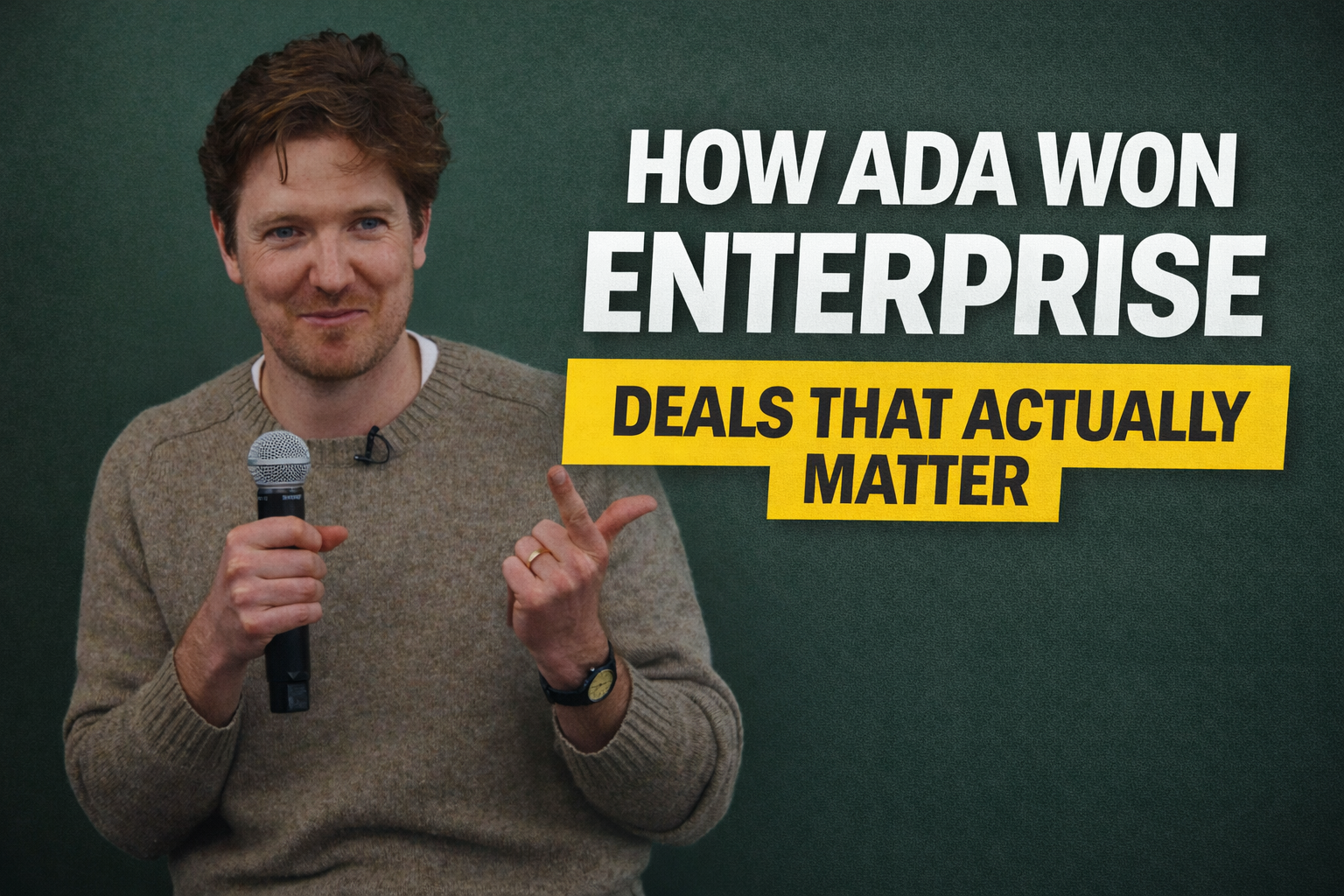
Lessons from Mike Murchison on enterprise growth, pricing, AI, and building from Canada
At the latest GrowthPad session at Stripe’s Toronto office, I sat down with Mike Murchison, founder and CEO of Ada, to unpack what it really takes to build an enduring enterprise software company.
Mike’s story is not the polished version founders usually tell after the fact. It is a story of getting close to the problem, working the front lines, underpricing early deals, learning enterprise sales the hard way, and building conviction in a market long before the hype caught up.
What followed was a candid conversation on startup formation, enterprise go-to-market, pricing mistakes, customer trust, retention, AI, and why more Canadian founders need to stop playing for second place.
A few themes came through clearly: great companies are built by obsessing over outcomes, not features; enterprise trust is still deeply human; and in the AI era, the winners will be the ones who combine product excellence with real execution in the field.
The company started with a customer service problem
Before Ada, Mike was building a very different company in the social search space. As that company grew, something started to break: customer service.
What had once felt like a close relationship with customers became a system of distance and defense. Feedback that used to feel valuable started feeling like a burden. The bigger the business got, the worse the customer experience became.
That bothered him enough to investigate the problem directly.
He cold-called customer experience leaders and heard the same thing again and again: customer service was treated as a cost center. Teams were rewarded for reducing contact, not improving relationships. The logic was operationally clean, but strategically backward.
That insight became the seed for Ada: what if the best companies could deliver better customer experiences as they scaled, not worse ones? What if growth created a personalization flywheel instead of distance?
Mike and his co-founder didn’t start by theorizing from a whiteboard. They embedded themselves in the work. They joined customer support teams, worked as reps, and spent a year learning the mechanics of customer service from the inside. Over time, they built technology to make themselves more productive. That manual experience became the foundation for the product.
That decision matters more than most founders realize. Many startups try to design solutions from a conceptual understanding of the problem. Ada was built from operational intimacy.
In the early days, the “product” looked a lot like a service
One of Mike’s sharpest points was also one of the most practical.
Founders often think landing the first customer is about building a repeatable outbound machine. In reality, the first customers usually come from delivering value however you can and then figuring out how to make that value scalable.
That is exactly what happened at Ada.
In the early days, customers were paying for a service outcome. Ada was not yet being sold as polished software in the way people would later understand it. Mike and the team were using AI behind the scenes to deliver the same outcomes more efficiently. In effect, they were running the perfect experiment: the customer paid for the result, while Ada quietly discovered the scalable advantage.
That is a much better mental model for founders than “build product, then sell product.”
The real question is not whether your first version looks like software or service. The real question is whether you are discovering a repeatable way to create value that can eventually scale far beyond your own labor.
Most founders focus on growth too early and revenue too loosely
Mike made a distinction more founders need to hear: in the early stage, it is not enough to chase revenue. You need to chase quality of revenue.
His test was simple and brutal.
Have a neutral third party talk to each of your customers and ask two questions:
- What are you using this product for?
- What value does it create?
If the answers are inconsistent, you are not ready to scale.
This is where many founders fool themselves. Revenue starts coming in, logos get added to a deck, and the story begins to look coherent from the outside. But underneath, each customer may be buying for a different reason, using the product in a different way, and deriving a different kind of value.
That is not scale. That is disguised consulting revenue.
True scalable growth starts when the value proposition becomes consistent enough that customer understanding, sales motion, onboarding, product roadmap, and retention engine all reinforce the same core use case.
Too many companies hire ahead of that consistency. Then they wonder why growth becomes expensive and fragile.
Why Ada leaned into enterprise instead of self-serve
Ada did not begin with an anti-PLG worldview. In fact, Mike is deeply product-oriented and instinctively drawn to self-serve software.
Early on, the company focused heavily on seamless onboarding and self-serve experiences for smaller customers, including Shopify merchants. But as larger customers started to come in, the team learned something important: the effort required to make a small customer successful was often similar to the effort required for a much larger one.
The difference was impact.
A larger customer could represent ten times the value, ten times the conversation volume, and far more strategic upside. That changed the company’s empathy. Instead of optimizing for the smoothest lightweight buying path, Ada began optimizing for how enterprise customers actually buy: through trust, consultation, assurance, and human interaction.
That shift is worth underlining.
The question is not whether PLG is good or enterprise sales is good. The question is: how does your target customer actually want to buy?
Enterprise buyers do not just want a demo. They want to know your team. They want confidence around security, implementation, support, and long-term partnership. They want to believe that if things go wrong, someone serious will show up.
That is still true in AI, maybe even more true.
Enterprise sales still comes down to trust
One of the most valuable parts of the conversation was Mike’s view on why enterprise deals get done.
Not features. Not AI demos. Not clever decks.
Trust.
In enterprise software, especially when a buyer is betting on a younger company, someone is taking career risk. Microsoft may not have the best product in every category, but one reason incumbents keep winning is that they feel safe. Nobody gets fired for buying the default.
A startup has to overcome that with a different kind of edge.
For an early-stage founder, that edge is often personal. The founder shows up. The founder looks the buyer in the eye. The founder makes the commitment directly.
That is a major advantage over larger incumbents, where the founder is nowhere near the sales process. Enterprise buyers do not just buy software. They buy conviction, accountability, and belief that the team on the other side will not disappear.
This is one reason many early founders make a mistake when scaling sales: they think scaling sales means hiring a head of sales too early.
Mike’s view is more nuanced. In the beginning, the bottleneck is not the sales team. It is the founder’s own selling capacity. The right first hire is often not a VP. It is a sharp operator who can work alongside the founder, learn the process, increase throughput, and grow into the role over time.
That is how Ada built its early sales muscle.
A great pricing lesson: chase the no, not the yes
Mike shared a pricing story that every founder should study.
During one of Ada’s first big enterprise opportunities, after multiple demos inside a large telecom, the team was brought into a boardroom and asked the question every founder wants to hear:
How much does it cost?
At the time, Ada’s smaller customers were paying around $500 a month. Mike responded with what felt like a huge number then: $5,000 a month.
The buyers said yes immediately.
That felt good in the moment. It was actually a mistake.
His lesson was clear: pricing strategy is about chasing a no, not finding a yes.
If a customer immediately accepts your first serious enterprise price, you probably left enormous value on the table. Mike said it took two years to unwind that decision, and the real value was closer to 10x what they initially quoted.
This is where many founders anchor pricing to what feels large to them instead of what is economically meaningful to the customer.
The right approach is to work backward from value creation. If the product is generating a massive business case, the conversation should start there. A good negotiation is not one where the customer says yes instantly. It is one where both sides work toward a structure tied to real outcomes.
That is uncomfortable. It is also how durable pricing gets built.
The best enterprise products get customers promoted
This was one of Mike’s strongest insights.
Ada has long believed that part of its job is to help the buyer succeed in their career. Not metaphorically. Literally.
That means understanding which metrics the buyer is measured on, what outcomes matter in their annual review, and what kind of transformation would make them look great internally.
That frame is powerful because it shifts product and go-to-market strategy away from generic value claims and toward career-relevant wins.
The most durable software partnerships are often the ones where the customer quietly attributes part of their promotion to your product.
That is what great B2B software should aim for.
Not “users love our interface.”
Not “we have a better workflow.”
Not even “we save time.”
Those are supporting details.
The core question is whether your product materially improves the standing of the person who championed you inside the company.
If it does, expansion becomes easier, renewals become stronger, and advocacy becomes more natural.
Retention is not one metric
On retention, Mike split the discussion into two separate lines:
- Net Dollar Retention (NDR)
- Gross Revenue Retention / logo retention
That distinction matters because these numbers can tell very different stories.
A company may have strong expansion from large accounts while quietly losing smaller customers. Or it may retain logos well but struggle to grow within them. Both scenarios require different thinking.
For Ada, expansion is deeply tied to channel breadth. The company started in messaging, but customer conversations happen across email, SMS, social, voice, and more. As Ada expanded into more channels, the opportunity to grow within accounts increased dramatically.
But Mike also stressed something founders often avoid: being ruthlessly honest about losses.
When customers leave, the goal is not to rationalize it. The goal is to understand it with clarity. Again, he suggested using a neutral third party where possible. Customers are often more candid with someone outside the day-to-day relationship.
Retention is not just a customer success metric. It is feedback on whether your original promise is holding up in the real world.
What most companies still get wrong about AI in customer experience
Mike was direct about what he thinks many companies misunderstand: they frame AI primarily as a cost reduction tool.
That is too narrow and often strategically wrong.
If the goal were merely to reduce customer service costs, the cheapest move would be to make it impossible for customers to reach you. That is obviously absurd. The real objective is to create a better customer experience, one that increases loyalty, improves lifetime value, and gives customers a reason to stay.
Ada’s framing is much stronger: the company sees itself as a customer lifetime value machine.
That is the right level of ambition.
AI should not just deflect tickets. It should help companies create experiences so effective that customers prefer them over competitors. Better support should strengthen retention, increase trust, and compound over time.
That is a more strategic use of AI than cutting headcount and calling it innovation.
The AI era rewards builders who prove things in production
The hype cycle around AI came up repeatedly, and Mike’s take was balanced.
Yes, the hype is intense. Yes, it is easier than ever to create a compelling demo. But there is still a major difference between something that looks impressive in a controlled environment and something that works securely, reliably, and globally in production.
That gap is where real companies are built.
The founders who win this era will not just be the ones who can present possibility. They will be the ones who can prove reality.
Mike also made a subtle but important product point: in AI, founders need to know which parts of their roadmap will improve with better models and which parts will get eaten by them.
Some roadmap items only exist because current models are imperfect. Those features may disappear as the underlying models improve. Other parts of the product become more valuable as intelligence, speed, and context improve.
Founders should bias toward building in the second category.
That is one of the clearest ways to avoid getting caught building temporary scaffolding instead of enduring value.
PLG is not dead. The lines are just blurring.
During audience Q&A, Mike gave a smart answer on the future of product-led growth.
The change is not that PLG stopped working. It is that many of the fastest-growing companies are now running multiple motions at once.
He used Anthropic as an example. Products like Claude Code can spread through self-serve adoption, but large enterprise expansion still requires traditional sales, security conversations, data assurances, and negotiated relationships. The bottom-up motion creates adoption and internal proof. The enterprise motion converts that into durable revenue.
That is an important shift for builders to understand.
The old debate framed PLG and enterprise sales as opposing strategies. Increasingly, the best companies are using both. Product creates pull. Sales captures strategic accounts and expands them.
The winning question is no longer “Which model are you?”
It is “How do these motions reinforce each other?”
A few rapid-fire answers that said a lot
Mike’s rapid-fire answers were short, but they carried real signal.
When asked about one growth lever more companies should use right now, his answer was simple: hop on a plane.
That is not nostalgia. It is strategy. In a world drowning in noise, in-person trust stands out more, not less.
When asked for the most overrated metric in SaaS, he said revenue. That fits with his broader argument: revenue without consistency or quality can be misleading.
The most underrated? Cohorted engagement. A reminder that durable product understanding often lives beneath topline numbers.
Best way to win the first enterprise customer? Work for the company. In other words, get so close to the problem that trust and value become undeniable.
Biggest mistake founders make with AI? Not using it enough themselves.
One habit that made him a better CEO? Writing.
And advice to his younger self? Remember that the journey is the fun part.
That last answer landed because it cut against the usual founder psychology. So many people optimize for arrival. The strongest founders eventually realize the challenge itself is the reward.
Why this conversation mattered
What made this session valuable was not just that Mike has built a serious company. It was that he spoke like someone still deeply engaged in the craft.
He did not reduce growth to hacks. He did not reduce AI to buzzwords. He did not romanticize the founder path.
Instead, he kept returning to a few durable truths:
- Understand the problem better than anyone else.
- Build around outcomes, not features.
- Get close to customers.
- Price against value.
- Use trust as a competitive weapon.
- Be honest about what is and is not scalable.
- Build products that get stronger as the underlying models improve.
- And if you want to win enterprise, show up like you mean it.
For Canadian founders, there was another layer to the conversation.
Mike was unapologetic about the need to build world-class companies from Canada, not as a compromise, but as an advantage. Talent, research, diversity, and ambition are all here. What is often missing is conviction.
That part is worth sitting with.
Because in the end, the best founders do not just build companies. They change what an ecosystem believes is possible.
Key takeaways
If you want the condensed version, here it is:
1. Start from the problem, not the category.
Ada did not begin as “an AI company.” It began with a conviction about customer experience breaking at scale.
2. Your first customers pay for outcomes, not architecture.
In the beginning, service and product often blur. That is normal.
3. Quality of revenue matters more than quantity early on.
If customers cannot clearly describe the same value, you are not ready to scale.
4. Enterprise sales is still deeply human.
Trust, presence, and accountability matter more than most decks admit.
5. Price to value, not to your own comfort.
If they say yes too fast, you probably priced too low.
6. The best B2B products advance the buyer’s career.
Build for the person behind the purchase order.
7. Retention needs separate lenses.
Expansion and logo retention are not the same problem.
8. AI should improve customer experience, not just cut costs.
The real upside is better outcomes and higher lifetime value.
9. Build where model progress helps you, not where it kills you.
This will matter more with every model release.
10. Founders still have one huge unfair advantage.
You can understand the problem more deeply than anyone else.
Watch the full discussion here.
Leave a Reply