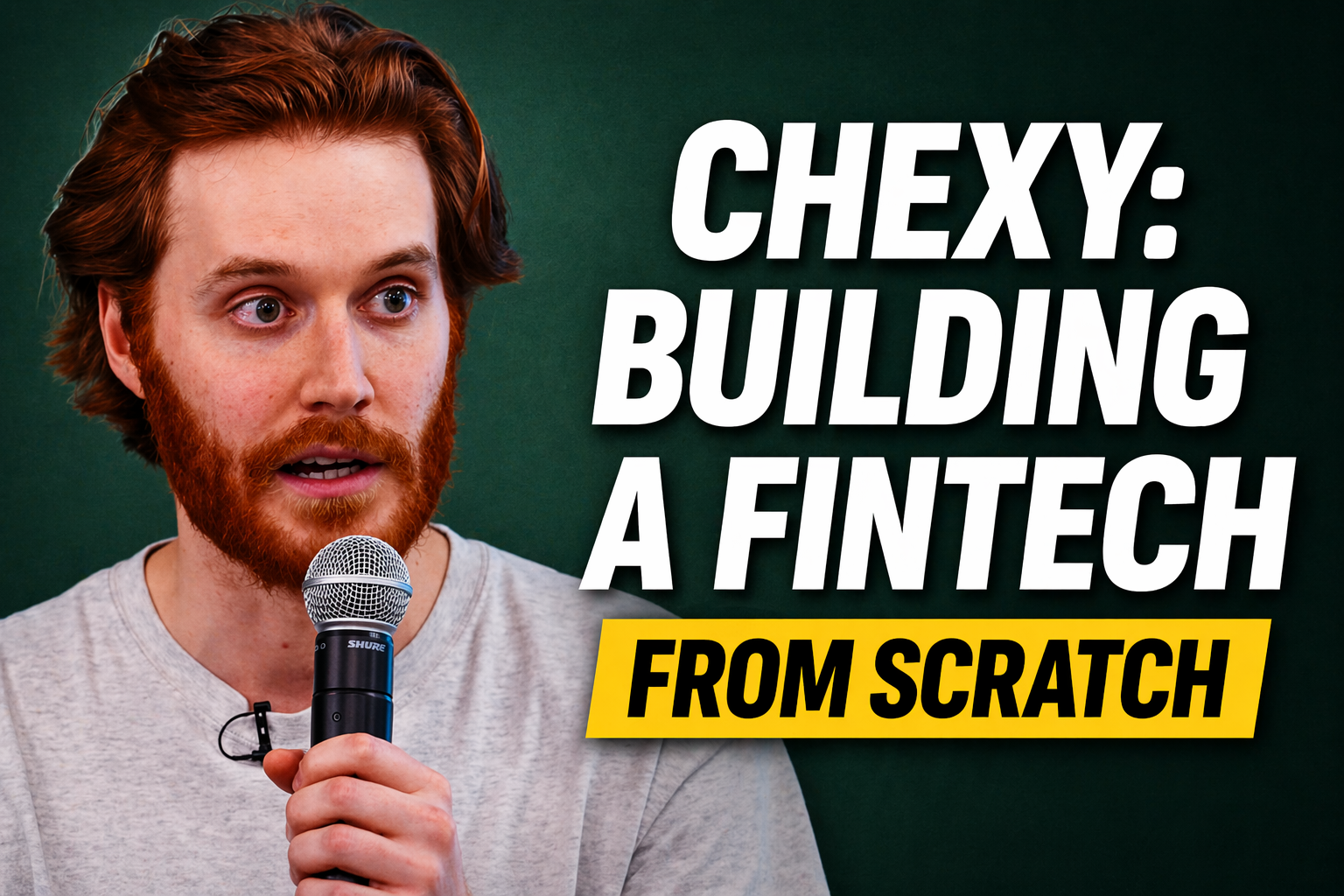
At the latest GrowthPad session at Stripe’s Toronto office, we sat down with Ben, co-founder and CTO of Chexy, the Canadian fintech that lets renters, taxpayers, and bill-payers earn credit card rewards on payments that historically earned nothing.
Chexy has gone from processing roughly $50M annualized in its early days to close to $1B annualized today. The company recently raised a Series A, launched its mobile app (which hit #4 in the finance category on day one), and is expanding from rent into bills, taxes, tuition, and business payments.
What made the conversation useful was how candid Ben was about the journey. He didn’t describe a clean arc. He described four years of figuring out who to build for, how to earn trust when nobody knew your name, how to land partnerships with names like Aeroplan, and how to stay focused in a market where a dozen shiny paths all look promising.
Watch the full talk here.
Below are the ideas that stood out.
Chexy started with a single, concrete observation
Before Chexy, Ben’s co-founder Liza was working at Square in Vancouver. In 2021, Square relocated her to Toronto. Her new landlord asked her to pay rent by physical check.
That was the moment.
In 2021, in the most overbanked consumer market in the world, the largest recurring expense for a majority of Canadians was being settled by a piece of paper. Roughly 60% of Canadians are renters. Rent consumes around 60% of take-home income, on average. None of that spend was earning anything. No points, no miles, no cash back, no aggregation into a financial profile.
Ben and Lisa met on the Y Combinator co-founder matching platform (essentially Tinder for co-founders), and the company was built around one crisp mission: become the best way to pay rent in Canada.
That mission mattered. It was narrow enough to be buildable, concrete enough to be fundable, and broad enough that it could unlock an entire category over time. A lot of founders try to start with a grand vision. Chexy started with a single frustrating moment and let the vision expand from there.
The first ICP was wrong. The second one changed everything.
One of the most honest moments of the night was Ben describing how long it took to figure out who Chexy was actually for.
The early thinking, like most startups, was “anyone who pays rent.” That isn’t an ICP. That’s a market.
They tried the top-down landlord play first. The logic was obvious on paper: sign one landlord with a thousand doors, unlock a thousand tenants overnight. It didn’t work. Landlords had tight P&L, heavy change management, and zero incentive to champion a no-name startup with tiny processing volume.
The real unlock came when Chexy stopped trying to be for everyone and zeroed in on a specific group: the churning community. These are the people with seven credit cards, spreadsheets tracking welcome bonuses, and deep knowledge of reward ecosystems. Not a mass market. The opposite, in fact. A small, highly engaged, financially literate niche that loved Chexy immediately because it was obviously, mathematically valuable to them.
That cohort did three things that mattered. They drove early revenue. They validated the product thesis in public forums like Reddit. And they gave Chexy credibility to approach bigger partners later.
Ben said it plainly: the biggest thing he would do differently is get to this focused ICP faster. In his words, “the energy of who would really care about Chexy was different from where we were looking.”
The first version of your ICP is almost always too broad. The second is usually a passionate niche you originally thought was too small. That niche is often where the real business starts.
Credibility was the hardest problem. Partnerships were the solution.
When you’re asking someone to route their largest monthly expense through your startup, trust isn’t a soft concern. It’s the concern.
Ben was clear that early-stage fundraising announcements don’t move trust. Nobody cares if you raised $300K. What actually moves trust is visible processing volume (“$150M processed this month”) placed directly on the website and in onboarding. Security certifications displayed prominently. Borrowed credibility from established partners. A polished, modern product experience that signals legitimacy.
The borrowed credibility piece is where Chexy’s story gets most interesting.
The Aeroplan partnership, with a name every Canadian immediately trusts, was a step-function unlock. Not because it magically produced millions of users, but because the moment Aeroplan’s name was attached to Chexy, a category of doubt disappeared. The implicit signal to every prospective user was that a company this well-known had already done the due diligence you were worried about.
How did that partnership actually happen? Not from a cold outbound campaign. It happened through internal champions. Aeroplan employees were already enthusiastic about Aeroplan points, discovered Chexy, realized they could earn points on rent, and advocated internally.
Ben made a point worth sitting with: partnerships like this don’t open the door, don’t close themselves, and aren’t a substitute for a real business. Chexy started those conversations in year two, when they were still small. The conversations took time. The partners wouldn’t have saved Chexy if the core business wasn’t working. They were, in his words, “a stepwise function,” not a lifeline.
As Chexy grew, the conversations got easier. By the time they approached American Express, Ben could walk in and say they were already processing $30M a month on Amex cards. That changes the conversation. You’re no longer asking for permission. You’re negotiating from signal.
Partnerships are earned by having a real business first. They’re accelerators, not starters.
Pricing was designed to be obvious, not maximized
Chexy charges 1.75% on payments. That number wasn’t chosen by anchoring to competitors. It was chosen by anchoring to user math.
The average Canadian rewards card earns around 2%. The best savvy users can push that to 4 or 5%. If Chexy priced above the average card’s reward rate, the value proposition collapsed. Below it, every user on a halfway decent card came out ahead.
Ben framed the goal precisely: make it a no-brainer once the user does the math.
This is an underrated pricing principle in consumer fintech. In a category where the product is competing against “doing nothing” (paying by e-transfer or check), you aren’t really fighting for margin. You’re fighting for behavior change. And behavior change only happens when the value is obvious and mechanical.
The model Chexy landed on is a win for both sides. They negotiate rates with card networks to create a spread. Users earn on the arbitrage between their card rewards and the Chexy fee. Chexy earns on the spread itself.
Pricing, in other words, was treated as a product decision, not a finance decision.
Staying Canadian is a strategy, not a limitation
One of the most recurring questions Chexy gets from investors and observers is when they’re going to the US.
Ben’s answer was one of the sharpest parts of the conversation.
Canada isn’t a small market. Canada is a structurally different market. It’s a country of oligopolies. Five banks. One major airline. A concentrated telecom landscape. A concentrated grocery landscape. In the US, a great company might have 1% or 2% market share. In Canada, great companies can hold 30 to 50% of their category. The available TAM gets much larger when your thesis is that you can own the market, not rent a slice of it.
Layer on another structural reality: Canadian fintech is 10 to 15 years behind the US. Categories that have been served south of the border for a decade have no real equivalent here. That gap isn’t a weakness for a Canadian founder. It’s a moat-building window.
The moment you cross into the US, you’re effectively starting a new company. Different banking rails. Different regulators. Different consumer behavior. Different competitive dynamics. The core value proposition might translate. The company around it doesn’t.
Ben was unapologetic. Chexy is Canadian. It will stay Canadian for the foreseeable future. The strategic logic is that the ecosystem here has reached a real inflection point. Toronto is now producing companies in the Shopify and Wealthsimple generational cohort, and a second wave of founders is emerging from those alumni networks. Talent density, capital availability, and ambition are compounding together. Building from here isn’t a compromise anymore. It’s increasingly an advantage.
The biggest mistake: lack of focus
Asked about the single biggest mistake of the Chexy journey, Ben didn’t point to a specific decision. He pointed to a theme: lack of focus.
Early-stage founders, especially now with AI lowering the cost of building, are constantly tempted by adjacent opportunities. Chexy had to repeatedly resist the urge to build adjacent products for renters (rental guarantees, alternative credit scores, tenant marketplaces), adjacent products for landlords, adjacent products on the business side. Every one of them had legitimate demand.
He quoted an investor’s framing that stuck with him: an A+ product beats two B products, even if the two B products make more revenue than the one A.
That’s uncomfortable advice for revenue-motivated founders. Especially at the pre-Series B stage, splitting your team across two decent products usually produces two mediocre outcomes. Building one exceptional product usually produces one category-defining outcome.
The discipline this requires is the ability to say no to things that look promising but are distractions in disguise.
For Chexy, that discipline produced a clear roadmap. 2025: the best way to pay rent in Canada. 2026: the best way to pay a bill in Canada. 2027 and beyond: the best way to move money in Canada. Every adjacent opportunity now gets evaluated against that progression. If it doesn’t fit, it doesn’t get built, regardless of short-term revenue.
Retention lives below the surface of features
Chexy’s referral coefficient sat around 40% for the first two years. That’s remarkable by any standard and close to unheard of in a fintech product with meaningful per-transaction fees.
That number wasn’t produced by a clever referral program. It was produced by two things. The underlying value proposition was real and measurable, so users could see exactly how many reward dollars they had earned. And the product experience was clean enough that recommending it didn’t feel like a risk.
Ben was candid that Chexy is still closer to a “nice to have” than a “need to have” in most users’ financial lives, and closing that gap is one of the more important challenges ahead. The strategy is to integrate more deeply. More payment types. More entry points. Eventually, money that lands in a Chexy wallet and flows out again. Each of those adds stickiness and network effects that pure transactional utility can’t.
On churn, Chexy does three things worth copying. They track churned users continuously and run automated re-engagement. They reach out manually to understand why, typically offering a small incentive to get about 0.5% of churned users on a call. And they watch Reddit closely, where honest feedback about financial products shows up in a way it never will in a survey.
Reddit is a dangerous place if you have thin skin, Ben noted. But it’s one of the most honest signal sources a consumer fintech has. The team’s discipline is to read it with empathy rather than defensiveness and ask, every time, what the real feedback underneath the tone is.
They hired their first salesperson four years in
This detail is almost too good to skip past.
Chexy, a fintech processing close to $1B annualized, hired its first salesperson two weeks before this fireside. For four years, virtually every customer (consumer and business) came through inbound, partnerships, word of mouth, the churning community, influencer mentions, and organic social.
The early waitlist story is worth telling. Chexy raised its first round in August and didn’t launch until March. In that gap, Ben and Lisa did student activations, university events, manual outreach, anything to build a list. By launch day, they had about 3,500 names. The first week, they personally called every single one of them. It was chaotic. People were texting Ben support questions a year later. It also worked.
Most consumer fintechs pour venture dollars into Meta and TikTok spend before their product-market fit is crisp. Chexy did the opposite. They manually built credibility with the people who already cared, and let that flywheel run for four years before adding formal sales capacity.
As they move into B2B (SMBs, dentists, doctors, small practices with real business Amex spend), the motion is shifting. They’re layering in sales. They’re building repeatable segments. The lesson stands though: inbound-first is a strategy, not a phase, especially when your early adopters are passionate enough to do the distribution for you.
What this conversation meant
The most useful thing about Ben’s telling was what he didn’t do. He didn’t pretend that partnerships were a straight line. He didn’t pretend the first ICP was obvious. He didn’t pretend every fundraise was clean, every pricing call was correct, every adjacent product debate resolved neatly. He described a real company with a real trajectory, built by a team willing to keep concentrating their effort until the thing worked.
A few principles kept returning throughout the night.
Narrow your ICP until one group genuinely loves the product. Partnerships come from business traction, not the other way around. Credibility is built by what you show, not what you claim. Price for behavior change, not for margin. Stay focused. Two B products don’t beat one A+ product. Build where your geography is an advantage, not where it is expected. Retention is the real distribution engine.
For Canadian founders, there was a second layer to the conversation. Ben was direct about building a generational Canadian company without apologizing for the market size. That conviction is increasingly what separates the Canadian founders who build category-defining businesses from the ones who default to “expand to the US” before they’ve fully won here.
Key takeaways
If you want the condensed version, here it is.
- Start from a single concrete moment, not a grand thesis. “The best way to pay rent in Canada” is a crisp mission. “Becoming the Plaid of Canada” is not.
- Your first ICP is almost always too broad. Find the niche that already loves your product and go deeper there before going wider.
- Credibility is a product feature. Processing volume on the site, security certifications, partner logos, and UX polish all do work that marketing spend cannot.
- Partnerships follow traction. They’re accelerators, not starters. Earn the right to negotiate from signal.
- Price for behavior change. In categories competing against inertia, value has to be so obvious that the math wins the argument.
- Canada is a structurally different market. Owning a category here is a bigger outcome than most founders realize.
- Focus ruthlessly. An A+ product beats two B products, even when the two B products make more revenue in the short term.
- Retention is the real moat. A 40% referral coefficient isn’t built by referral programs. It’s built by real value and clean execution.
- Inbound-first is a strategy. Chexy hired its first salesperson four years in. Passionate niches will distribute for you if the product is strong enough.
- Build where model progress, geography, and ecosystem timing work in your favor at the same time. That’s where the quieter unfair advantages sit.
Leave a Reply